Friday, May 6, 2011

¡Gracias por leer! (6)

Hey! Thanks for checking out the last blog post about my junior year abroad.. I've actually been back in the USA for over a week now, so I figured it was high time to wrap up the blog project and move on!

So in the last post I talked a bit about our geology course and one of the cool (and half-naked) excursions we went on.. Turns out we got to do some more cool stuff! For example, we traveled by boat to a bunch of different islands within the Bocas del Toro archipelago and took samples of rocks ranging from 6.9-1.4 million years old. "Taking a sample" basically means that you get to hack like crazy at the rock with geological picks, kinda like the ice picks used in lobotomies, but not exactly. Here's a pic of my friend Jacinto as he prepares to hack a sample out of the rock.


In case you're wondering, the rocks were pretty soft so it's not that daunting to chip away at them.

After taking samples, we cleaned and sorted all the invertebrates that had been inside the rock. It's neat, because you can tell a lot about climates that existed millions of years ago just by looking at the kinds of inverts associated with them. For example, we found corals in our younger samples and not the older samples, which is consistent with corals evolving and spreading in the Caribbean after the isthmus of Panama closed ~3.4 million years ago. Geology = fun fun fun fun

Our last class had an archaeology component in addition to the geo.. And the highlight was definitely a visit we made to a village of Embera Indians, a people proud of their strong cultural heritage and connection to the environment. The idea behind our visit was to learn about their way of life and, in exchange, provide them with funds for their new community center.

Much of our visit was spent learning how to make baskets. It was SO COOL (not kidding). We used dyed palm fiber and thread to construct these sweet little multi-colored baskets. I'd call it weaving, but it wasn't exactly that. Basically you add each new layer of palm fiber on top of the last and stitch them together with lots of little in-and-out connections. F'sho made for a unique "classroom" experience. Here's what my final basket looked like:


my 'lil basket! a little mishappen, but functional


an Embera child and me (plz note my tat)

The Embera also danced for us and made us a traditional lunch of yucca, rice, and chicken (served in a leaf!).. And the lemongrass tea they served was unreal. So delicious. Aand we got these nifty legit-looking-but-actually-temporary tattoos whose ink comes from a seed the Embera collect in the forest. Here's Karen getting her leg done up:


nnice

Another cool thing we did was to visit this old Indian burial site somewhere in the heart of Panama. Basically, for the past 5 years archaeologists have been excavating this site, which has produced an incredible array of skeletons, pottery, GOLD, jewelry, and other amazing artifacts. There will be a Nat Geo feature on it coming out in Jan. 2012, so look out for that.

At any rate, we saw the super-pro archaeological site and then did our best to imitate it by starting our own dig nearby. It was actually pretty legitimate, because we used all these fancy tools and had to dig down carefully and systematically. We found a lot of ceramic pieces, pottery, etc. which was exciting. Some EEBers even found some animals bones..! Here's a pic of our little plot after 2 days of digging:


hard at work


some of the boss tools we used


drigo's friend at the archaeology site


a boa that got into our dorm!

Everything that happened after the dig wasn't that exciting.. Papers, exams, etc. And man, when I first got back to the States last week, it felt really weird. The boondocks of Panama to Princeton houseparties weekend is a pretty stark transition. But still it's really, really good to be back and see many of you guys again!

Final Reflections
After a full academic year abroad and the process of growing through a whole slew of new experiences and opportunities, all I can really say is that I feel incredibly blessed by God. I've been so fortunate to have the cultural and language immersion in Europe and then the field biology immersion in Panama, and I'm really grateful for the friends and family (that's YOU ALL) I've been able to share those times with. It's funny, I've just sort of been typing away about my thoughts and doing my thing, but then hearing your responses and comments reminds me that others are thinking about me and have some interest in what I'm doing.. and that's been a wonderful realization that you guys have given me over and over. Thank you for that.

SO, I really appreciate your sticking with me throughout the blog's development. You guys have really been the heart behind this project. Without you, I for sure wouldn't have had the motivation to record what I've been up to. I'll miss traveling & blogging, but at the same time it's satisfying to bring my Estancia en el Extranjero to a close.

Love,
Dave

Thursday, April 14, 2011

¡Soy arqueólogo! (5)

Well howdy there everyone.. Thanks for checking out the fifth (and, I think, penultimate) blog post detailing my time in Panama.

So we've finished up our stay on Barro Colorado Island (BCI), which is a rain forested-coated a few miles from Gamboa and (I learned recently) the best-studied rain forest in the world. Kinda cool!

If you remember from the last post, I was driving howler monkeys crazy with a big stuffed jaguar:


J-Diddy chilling in the beautiful old-growth forest (with a carpet of purple flowers) on BCI

Our freak-monkeys-out experiment turned out to be a success and was lots of fun. (We basically found that (a) howler monkeys reacted the same way to a 3D and 2D stuffed jag model; and (b) the only difference between the two models was that it took monkeys longer to decide that our flat, 2D model was a "threat" to them.)

While on BCI, I also got to see/film two poison dart frogs mating.. They are so intense! Check it out

I really grew to like a lot of things about BCI. The crazy-about-science attitude, the fridge full of Balboa and Panama beers that was treasured by the whole island, the samba dance parties on the patio, the AMAZING food (no joke), the friendly people, and - of course - the ridiculously cool natural life were all positives.


This is Big Tree. You can't really get a scale for the size here, and you can't even see the top of it in the pic.. But take my word for it: the tree is huge.

The only bad thing about BCI is that it's a small island with no more than 50 people around at a time. Which means the island is a great place to focus on research, but it can also become dangerously boring.. Think about it: it's just you, animals, and a few other researchers.. who you see ALL THE TIME. Even after just 3 weeks, I was ready to get back to the mainland - I can't imagine how people live there for a year!

---------------------------------------next topic------------------------------------------------

Soo right now, we're back in Gamboa, working on our fourth and final course. It's different from the others - focused on geology & archaeology, rather than tropical biology.

Today was pretty exciting. We went out to a few different field sites (ranging from 6-18 million years old) looking for fossilized marine organisms.. We saw a lot of bivalve (oysters, barnacles, clams) fossils, tons of snail shells, and some cool things like shark teeth.

I actually got lucky and made a pretty exciting find - some kind of vertebrate tooth which our prof thought might be from a killer whale. It's a neat fossil because marine mammal teeth are generally much more rare in the fossil record than shark teeth are, since sharks shed their teeth & mammals don't. The prof was excited and wants to send it off to a lab to get tested and stuff. Here's a pic:


Cool!

But even cooler than the tooth was doing paleontology in our boxers. At our second site, we had to get across this little bay to look at some rock formations, and we were totally unprepared for going for a swim. Our professor, an adventurous Englishman, had no problem wading confidently into the water (fully clothed), and it was so funny to see his reaction to our group's entry into the water. It was like those wildebeest herds on their great migration when they stop at the river to think about the crocodiles and then finally decide to make the plunge. Except for our group that meant that Princeton EEBers - guys and girls alike - started stripping left and right, pulling off shoes, shirts, and pants before making the plunge in underwear.

I happened to be in the water next to our professor and just watched his face morph into a blend of wry humor and mild contempt.

Some memorable quotes from the afternoon:

"What the hell are they doing?" [our prof, watching awestruck as everyone figured out how to get in]

"Is there anything unpleasant in the water?" [me, referring to things like jellyfish, crocodiles, sharks..]
"Just you guys" [prof, still incredulous]

"I bet no one listened to a word he said, since we were all standing around in our underwear the whole time" [girl in our class, referring to our 45-min lecture once we got out of the water, huddled around a 6 million-year-old wall of rock, in minimal clothing]

"Dang it, these white boxers are see-through!" [guy in our class after getting in the water. he held a hand over his sweet spot the rest of our time at the site]

"So people get in their underwear here a lot?" [Our group to our prof]
"Not really, no. Just you all." [Prof]

"Fossils have never been so sexy" [fb status after getting back to Gamboa]

Aaand here's a picture of our motley crew after our wet excursion:


Classic

A few final thoughts:

1) We've adopted an adorable kitten who hangs out near our schoolhouse in Gamboa. Its name is Lolly, in honor of our charming EEB departmental rep in Princeton. Some fotos:


Lolly the kitten

2) Today, a 24 oz bottle of insect spray (sent to me by my loving dad) really completed my already-impressive arsenal of poisonous chemicals for combating mosquitos et al.:


Totally absurd quantity of insect repellent
(Note: I just discovered two more bottles not included in the picture. Ostia.)

3) And FINALLY, the Barca pride from last semester definitely hasn't worn off. Why do I bring this up? Because, for the first time in history, FC Barcelona -- the good guys -- and Real Madrid -- the bad guys -- will be facing off FOUR TIMES in the next 18 days, starting this Sat, 4/16. At stake is a lot of glory and bragging rights. First, they'll play each other in the second installment of La Liga action, with Barca trying to maintain its substantial but not unsurmountable 8 point lead in the standings. Second, the two Spanish powerhouses will face off in the final of the Copa del Rey. And third, they'll do battle in the home and away legs of the Champions League semifinals. So the four Clásicos should make for some really exciting action - enjoy!

Tuesday, March 29, 2011

Una maravilla a un lado y un bosque al otro (4)

Hey! Thanks for checking out blog post #4 from Panama. It's hard to believe, but only 1 more month of Central America before I head back to Princeton. Wild.

Alright so this update picks up over spring break, when I had the pleasure of my parents, brother, and the bro's gf visiting for most of the break. It was great to see them, hang around the city, and even show them a bit of the rain forest. However, the coolest part was definitely crossing the Panama Canal..

Some fun facts:
>The French tried to build the canal first. They attempted to blast through 50 miles of solid rock. They failed.
>U.S. engineers developed a far more elegant solution involving two sets of locks that raise and lower ships across the isthmus, using gravity to move water.
>After its successful completion, the canal was billed as arguably the most impressive engineering feat ever and the 8th wonder of the world.
>In 1928, British adventurer Richard Halliburton - a Princeton grad! - paid a whopping fee of 36 cents and became the first (and only, it's now illegal) human to swim across the canal.
>The Panama Canal uses the same iron locks today as it did when it first opened almost 100 years ago.
>A current expansion project (due to finish in 2014) will allow the canal to handle the ever-larger container ships being built.

For more background on the canal, I recommend checking out my big brother's well-written, informative post here.

Getting back to our crossing: As we embarked, I was really excited to get a better idea of how a ship 3x as long as a football field could be hoisted up and down just by water power. Our trip started out on the Pacific (south) side of the canal, where our passenger boat steamed ahead toward the famous Bridge of the Americas. It was cool seeing (and passing!) all the giant boats patiently waiting their turn to enter into the canal, which saves them roughly 8,000 miles of travel and hundreds of thousands of dollars in maintenance costs by providing a direct conduit between the world's two great oceans.

As we got to the first lock, our guide explained how the immense amount of water in the Chagres river provides the incredible power that raises and lowers the dozens of monstrously big ships that pass through daily. Via vents in the bottom of each lock, water rushes in or out of a lock to move the boats 27 feet vertically in just 8 minutes. That sounds pretty slow, but having seen & experienced it, that's actually a remarkably fast rate!

Our boat shared a lock with a larger ship (the canal obviously tries to maximize the number of vessels that go through), so we were able to observe first-hand how a ship gets through. I'll spare you a detailed explanation of the process, but there's a cool little simulation here.

Some pics from the crossing:


me & the bro


the panama canal is the only place in the world where a ship's captain is required to relinquish control of his vessel.. he has to hand it over to a specially-trained canal pilot. here's the big-shot pilot for our boat, about to board


a big cargo ship coming the other way, 20-some feet above us


the boat we shared a lock with.. notice how close the edges of the boat are to the sides of the lock!


the lock gates are HUGE


Bridge of the Americas


Next topic - our third class is taking place on an island called Barro Colorado, in Gatún Lake. BCI is a sweet place, because there's really great rain forest and a ton of amazing flora & fauna that are super easy to study - they're literally right next to the field station. Our course is focused on the ecology & evolution of predator-prey interactions, and we're working in groups to study predator response in howler monkeys, agoutis, and tungara frogs.

My partner and I chose to study howler monkeys and see how they respond to different jaguar models.. The idea is to see if the monkeys exhibit different anti-predator responses according to the presence or absence of three-dimensionality in a predator stimulus.

Translation? We're scaring the bejeezers out of howler monkeys using a huge stuffed jaguar. As you might imagine, it's really really fun.. Here's the jaguar we've been using to scare the howler monkeys:


J-Diddy

We'll also be using a 2-D version of the stuffed jaguar and a flat, rectangle-shaped control to try to see just how good monkey vision is.

I'm not really feeling the writing flow too much today, so I'll spare you some verbage and leave you with neat videos of (a) a devil dance we saw at a festival in Colón; (b) howler monkey alarm call (showing monkey); (c) howler monkey alarm call showing J-Diddy the jaguar; and (d) leaf-cutter ants in Gamboa.. They're all short!

I have really bad luck with uploading videos to blogger.com, so I've put the videos on youtube.

Devil Dance
Howler Monkey 1
Howler Monkey 2
Leaf cutter ants

Sunday, March 13, 2011

Los bichos marinos (3)

What's good everybody.. Spring break is here, we've finished up two classes, and the stay in Panama is halfway over! I haven't posted for a while so I've got a lot to update you on BUT first, major props to Princeton Men's basketball for their stylish W yesterday over Harvard.. Check out the winning buzzer-beating shot if you haven't yet. I've watched this so many times.. So proud to be a Tiger right now.

Alright so we just finished up our three weeks in the coral reefs.. The first leg of the trip was to the San Blas islands where the Kuna Yala - a native people of Panama - exercise self-rule and preserve their unique culture. To get there, we had to fly in this super-sketch airplane that was probably made in the '80s. It had like algae or fungus or something growing on the wings, this retro wood paneling along the sides, and pilot controls that looked like they were made for a toy.. However, 25 minutes of exhilarating flight and we were in San Blas! At the airport island where we landed, we were treated to some traditional Kuna dancing.

Close by the airport was the tiny island, which (like many of the 300+ islands in San Blas) was smaller than a football field. We stayed at a little Kuna- run hotel with no internet, running water, or round-the-clock electricity.. the toilets even flushed directly into the Caribbean! Despite the lack of normal amenities, the island was actually really awesome. In addition to the friendly Kuna, we had two dogs, two cats, and a personable little parrot to keep us company.


Ok as for the reefs - so, so amazing.. I knew coral reefs were the tropical rain forests of the ocean or whatever but there's nothing quite like being surrounded (literally: under, above, and to either side of you..) by the dazzling array of colors and life found on a reef. I saw wayy too many species in San Blas to name (and the species list to your right is woefully incomplete) but some of my favorites were parrotfish, lion fish (introduced), french angelfish, the slippery dick (i promise it's real), a spotted eagle ray, a spotted drum, and some way cool squid.

As much as the species richness in the water bowled us over, San Blas is actually home to pretty degraded reefs.. The Kuna rely heavily on the sea to eat, and as a result they've fished out almost all the big predator and herbivore species that are normally found on healthy reefs.. Because the big herbivores aren't there to eat the algae (normally responsible for only 10% cover on a pristine reef), algae has taken over where coral used to be and the whole system suffers.. Also, the absence of sharks, big jacks, hefty snappers, and other top-dog predators was noticeable. The San Blas leg showed us first-hand how tough conservation challenges often involve a balance between people's needs and the environment's health.

Although it was a bit sad seeing the reefs in a less-than-ideal state, there were still so many other positive things to focus on.. Like the Kuna culture and the beautiful molas the women embroider, the absolutely picturesque beaches where we got to eat lunch, the bath-tub warm water in the shallows.. Maybe most of all, I loved that "going to lecture" meant learning about coral reefs over breakfast, in bare feet, with a dog and cat playing under my feet and a day of boat-riding & snorkeling in tropical waters ahead. You know those get-away advertisements with the white sand beach, the coconut trees, and the teal/aquamarine waters?? That's where we were.


the good life on San Blas

Ok, Part 2. After San Blas and a quick pit-stop in Gamboa, we headed out to Coiba, Panama's biggest island and a formerly notorious prison. Until 2004, the island housed a number of penal camps where some of the most ferocious criminals, and later Noriega's political prisoners, served harsh sentences. Stories of tough prison gangs, beheadings, and hangings abound.. But the good part of that past is that, because Panamanians always kept clear of Coiba, the natural environment today is virtually untouched.. And now Coiba is one of the most important nature reserves in Latin America!

We quickly learned that one of our island neighbors was Tition, a huge >7 foot american crocodile.. Park rangers feed him fish and raw meat, so he's learned to hang out near people (not great). But, it meant that we could get some cool views and pics, like this one:


Right after our first time snorkeling around Coiba, the difference in the reefs was obvious for two reasons: (a) different species of fish and coral and (b) a stark contrast in the quality of the reefs. The algae cover was greatly reduced by enormous parrotfish and other herbivores and the predatory fish were MUCH bigger and more abundant than they'd been in San Blas. We saw whitetip sharks, jacks, snappers, and moray eels patrolling the water... oh and also SEA TURTLES. I swam with some greens & hawskbills and two little hawksbills even let me touch their shells. unreal.

The only bad part was that, part way through the trip, the jellyfish community decided to invade our snorkeling sites and torment us.. A couple of the times we went out, we literally got stung every 10 seconds - on the arms, neck, face, chest.. Aaah those little cretins were so miserable.

Our last day at Coiba we visited one of the old maximum-security prisons.. It was eerie to see the run-down building with its bare concrete, rusting iron bars, and painfully cramped cells. One of the guards told us all about the horrific violence that occurred once upon a time within the prison walls..

But an unexpected and very beautiful side of the visit was seeing some of the hopeful art - unpreserved and fading but still visible - made by some of the prisoners in the midst of brutal conditions.


This means "With the fear of the Lord men depart from evil" (Proverbs 16:6).


This painting contains phrases that mean "There is no friend like Jesus," "God is Love," and "Jesus is our Savior"

Part 3 (hang in there, almost done). To finish our trip we headed to the Azuero peninsula to stay at a beautiful tuna-farming facility. This trip was inspiring for two reasons: (1) The Irish-American that runs the lab is basically trying to find ways to produce cheap, sustainable tuna that could change the way the world gets protein. (2) The same guy is doing a really neat re-forestation experiment.. If his idea works (and it looks very promising), cattle ranchers - instead of cutting down forest - could plant hardwood and lumber trees that would provide habitat for animals, restore forests, and result in 10x more income than cattle grazing does. Money trusts could absorb the set-up costs and provide loans during the 35 yrs it takes the trees to grow.


little tuna guy

That's it for now! I'm currently chilling at a hostel in Panama City, waiting for the fam to show up and being taken care of/gently chided by the maid who alternately calls me mi amor or mi corazón.

Oooh and my friend almost got hit by a sloth falling out of a tree.. this video of the dazed sloth gathering his bearings is really cool/funny: http://www.youtube.com/watch?v=rly4Hpz74RI

Sunday, February 20, 2011

Aventuras en la selva tropical (2)

Well howdy there everyone.. Thanks for tuning into installment #2.

First things first - I want to publicly exonerate the Panamanian police and apologize for casting false aspersions on their character (see panama blog post #1).. I learned later that they were not, in fact, guilty of accepting a bribe from us. (Turns out my TA made that story up.)

Second, we're already done our first course! Crazy, right? Here are some cool/funny/ridiculous things that happened to us while we were in the field:

1) "Explosivos No Detonados": So we get to our third field site and we're prepping our stuff for the day etc.. And I happen to glance at a yellow-and-black sign that says "Important Safety Warning." So, figuring it's talking about like poisonous snakes (rare) or wearing hard hats under the canopy crane (really?), I lazily read the first few words. Then this sentence jumps out at me: "It is imperative for all researchers to be aware of the possibility of encountering unexploded live ordinance." I don't know what live ordinance is exactly (at this point), but my attention has been sufficiently won. So I read the adjacent sign in spanish which says "Es imperativo que todos los investigadores estén alerta a la posibilidad de encontrar explosivos no detonados." EXPLOSIVOS NO DETONADOS = UNDETONATED EXPLOSIVES! So of course I'm thinking "What the.." and I ask my TA if this is a joke and her response is "Well, you know, it's very unlikely that you'll run into anything.. But it is possible. Last year someone found a grenade." !!!! Translation = we're going to be walking around on a veritable mine field.

(Switch to past tense) I was also really worried because my group of three was going 150 m into the forest (farther than anyone else) over and over.. But we got together and prayed and braved the forest.. And nothing happened which is great. But I feel like seeing these kinds of signs is just one of those things that wouldn't happen in the U.S.. It feels so foreign to me for someone to know that ppl could get hurt/killed doing research and then put a sign up and leave it at that.. rather than safety-checking this park that researchers use all the time! (Ironically though, U.S. forces were the ones using the place for training..)

Anyway here's a photo:


no me digas!


2) This next topic touches on something I forgot to mention in my first post.. Which is that it's REALLY EASY to lose your way in a rain forest. I discovered this my first day in the field after I made a short detour to a nearby stream to get a rock for one of our traps.. As soon as I had turned a couple of times, I realized that I didn't know which way was which - all the forest looked the same! Luckily a friend was nearby and led me back to my group, but it was a good first lesson for me.

Building on that, last week someone in my group got lost in the rainforest for realz.. It was funny at first because the person in question is a pretty confident dude and generally good in the forest. Butt after over an hour of not hearing him, we all got pretty worried. Soon enough the prof was driving up and down the road honking his car horn super-loudly, and a bunch of students were yelling in unison to try to attract him to the road.. Still no luck. Eventually a last minute phone call (seconds before the lost person's phone died) reminding him that the sun sets in the west ended up saving the day..

Some reflections: We found him a little after 4:00 pm, but what if it had gotten dark sooner? This guy happened to be without a compass, without a knife, without food or water, and with only a dying cell phone.. With a tiny bit less luck, he'd just be chilling with the howler monkeys, jaguars, and mosquitos for the night!.. AAAH that'd be so bad. The whole situation makes me cringe and hopefully reminds you to not take nature lightly. And the crazy part is that he was just walking from 150 m into the forest to the nearby road (with flagging marking the way).. and ended up kilometers away! While my buddy made a few avoidable mistakes prior to getting lost, it's totally the kind of thing that could happen to anybody, so take note.. It's really true that the biggest dangers in a forest are not getting bit by an eyelash viper or eaten by a jaguar. Rather, it's things like getting lost, or falling & breaking something, or contracting malaria..

3) In typical Panamanian/not U.S. fashion, simple things fail to be executed properly. Locked gates that shouldn't have been locked (2x).. Guaranteed reservations that weren't guaranteed (and vice versa actually).. Poorly translated signs..

I hope I don't sound like I'm complaining.. B/c actually I think this laid-backness/tranquility is pretty funny and charming MOST of the time, but sometimes it just makes me shake my head in disbelief! Just like in Spain, the overriding attitude of most people here, I think, is something like this (don't get craaazy.. these are obvy generalizations):

US ATTITUDE
A) Was something done? I'll go check.
B) If not done correctly, we need to fix it right away
C) If it wasn't fixed properly, immediate and drastic response needed. And possibly a big apology. Ensure problem will never occur again.

PANAMA ATTITUDE
A) That something was probably done. No need to double-check.
B) If not done correctly, no big thang.
C) If something important didn't happen properly, then just chill and
smile anyway

--Again, not raggin on panamanians.. They're great. Just my observations of broad cultural differences--

Ok in other news: My splinters-caused-by-vicious-forest-plants count has continued to rise.. But that should stop since WE'RE GOING TO THE CORAL REEFS NEXT!.. Umm rice and beans are the staple food here, like no joke.. For two nights we stayed in a quaint little town that had this amazing relaxed feel to it (see "Panama Attitude").. People had chickens and cows and things in their front yards, and there were THREE CHURCHES on just this small little <1 mi stretch of road. Such an amazing, quiet place.. (Except for the brightly-graffitied party buses roaring by a few times a day.. Still haven't completely figured out this fascinating aspect of panamanian culture.)

So that's pretty much all I can think of for now. It's so nifty to have these three-week courses. They're cool because you can focus intensely on something for awhile and then be done and go to the next thing.. HEADED TO DA REEFS THIS WEEK BABY!

Finally, some fotos below. Thanks for reading!


hawksbill sea turtle.. pretty endangered

so these ants will just bite your hand and can't get through the skin.. except when they find a soft spot (this one eventually did)


nice!

kickin' it w/ the prof in the canopy crane

got to check out the panama canal on the water today.. yehea

prof tryna hack through lock that was keeping us from leaving ha

sweet little church

Sunday, February 6, 2011

Panamá: ¡Qué guay! (1)

Watsup everybody! After a January hiatus, the update blog is back, but this time it's Panama-style.. I probably won't be posting as frequently this spring as I did last semester, but I'll shoot for at least biweekly blurbs. You'll notice that the box w/ Barca's Liga standings (on the right) has been replaced by a growing "Cool Animals Spotted" list, but otherwise the blog's layout is pretty similar.

Cool, so let's get to it: our group of 18 Ecology & Evolutionary Biology (EEB) majors got here a little over a weeek ago. We'll be moving around to different parts of Panama throughout the next few months, but currently we're in Gamboa. Gamboa is located in both the middle of the country and the middle of the Panama Canal (directly next to us), and it's also known as the world record-holder for most bird species counted in a single day: 385! While it's a quiet town, Gamboa also boasts a new resort, a cool church right next door to us, and a friendly population of local people. (I knew I was outside the U.S. when I found a pick-up soccer game within my first 3 hours here.) Our home base is affectionately called the "schoolhouse," which is actually a historic building operated by the Smithsonian Tropical Research Institute (or STRI). We're lucky to have (mostly) hot showers, (mostly) decent internet, and an awesome Panamanian lady named Frances who cooks for us.

For our first class, Tropical Biology, we have a French professor, two Panamanian TAs, and a Panamanian student who's studying with us. Class is a lot of fun: the first three days we just had a few hours of lecture and then went hiking through various rain forests. Now, however, we've started our research projects, so we're in the field most days and then come back for dinner and a 1-hr lecture in the evening. In my project, I'm using ant pitfall traps to see how the diversity of ants changes between forest edge and interior habitat. Basically my partner and I place these cups in the ground and bait them with tuna surrounded by a moat of soapy water. The ants fall into the water on their way to the tuna and drown. A bit morbid, I know, but it's kinda fun to see all the different ants that end up in our traps.


looks like a pair of lips, right?


da rainforest!

The other thing about my project is that it requires walking 150 meters into the rainforest, over and over. I quickly experienced first-hand just how ultra-adapted tropical plants are for protecting themselves.. Evolution has blessed some of the plants here with huge thorns, fearsome spines, super-sticky seeds, ant armies that protect their hosts like it's nobody's business, and a variety of other ingenious characteristics that are no fun for humans. The flora seem to take great delight in deploying their defenses at the expense of the rainforest explorer, as my cuts, scrapes, bruises, and other assorted wounds (physical and psychological) can attest to.. As for animals, I've noticed that my initial impression of rain-forest fauna was incorrect: it's not like there are snakes dripping off every tree or frogs jumping over your boots non-stop. The biodiversity is absolutely present, but many animals are nocturnal, or come out more when it rains (it's the dry season now), or hide when they hear people coming. I keep waiting to step on a poisonous snake or get bit by one hanging overhead.. the possibility is always kicking around in the back of my head as I stomp clumsily through the forest.


gecko guy


one of a number of wonderful & beautiful flowers in the forest

Ok to wrap up I will tell a story. We had a rest day today, so we went to a beach on the Pacific side of Panama. The beach was over 2 hrs away, but when we had finally almost arrived, we were stopped in front of a police station by five Panamanian rifle-wielding officers. After our driver spoke with the policemen for a few minutes, we were told something about how a law passed "moments ago" would prevent us from driving the remaining 6 miles to the beach in our bus. Now, Panama isn't exactly known for enforcing its laws perfectly, AND it was a Sunday, so the idea of a law passed just an hour ago or whatever seemed absurd. (I suspect something was lost in the translation we were given by our TA..) Then our TA told us that the law had to do with whales, walls, or waves, but we couldn't understand which he was talking about since he had problems with that particular word. As you might imagine, our whole group was very confused by this point. Eventually, a $100 bribe from our driver seemed to satisfy the officers, and after a passport check (no idea why) and a second, unexplained stop, we finally hit the beach. I'm not sure what the moral of this story is.. but where logic fails, money seems to speak.

Friday, December 24, 2010

Moltes gràcies, Barcelona - 17

Hey! Thanks for checking out the last blog post on my fall semester in Barcelona.. It's been a lot of fun for me to put these how-do-you-dos together, and it's also been a good excuse for keeping a chronicle of my trip that I can look back on. I'm humbled that y'all have checked out "Una Estancia en el Extranjero" over 2,000 times from over a dozen countries. If you've found the updates even mildly entertaining, then I can quite happily say that my blog has served its purpose.

So this last post I'm writing from the good 'ol USA; I arrived back home late last night, after experiencing my own share of the weather mess that has plagued Europe this past week. As the columnist mentions, the whole European airport freeze seems a bit absurd: "It snows in winter. This shattering discovery has now cast Britain and France into chaos for a week, with London’s dysfunctional Heathrow airport leading British claims to be officially designated a third-world nation." In my case, Brussels hadn't quite figured out how to obtain enough de-icing fluid for their planes, so my Tuesday departure for the U.S. was delayed for two more days.. Although the really frustrating part for me wasn't even the two-day delay, but just trying to figure out what was going on after my flight was cancelled. The Continental window at Barcelona's airport is conveniently open for three whole hours a day, and amidst the chaos of many other people trying to figure out what was going on with their flights, it took me five hours - of phone calls, waiting, and communication with three different airlines - to get my flight re-booked. I'm still not sure I understand what happened, because Continental was blaming Brussels Airlines, Brussels was blaming Continental, and United Airlines (which, just to make things interesting, has sort-of merged with Continental) was thrown in the mix somewhere along the way. But the good news is that my re-routed flight took me through Madrid, which meant that yesterday I was able to avoid the disaster areas of London, Paris, Frankfurt, Amsterdam, and Brussels..

But enough of the travel situation. In this adéu to Barcelona, I figured I'd make a list of things I'll miss about that singular city and its myriad charms (the rankings have no bearing on their value, btw):

#1 - Carlos the Security Guard. Always cheerful, he would often greet me by name as I left my student residencia.

#2 - GBU. Grupos Bíblicos Universitários, a Christian group at the Autònoma, my university in Spain. Great, scripture-loving people.

#3 - Pick-up soccer games. Playing with Spaniards is always fun, as they're very skilled passers who teach you how to make the ball do the work.

#4 - Gaudí. The man, the legend. And the architect! I'll definitely miss seeing his zany but awesome creations, like the Pedrera, the Sagrada Família, and Parc Güell.

#5 - CASB. That's my study abroad program, the Consortium for Advanced Studies in Barcelona. While it's dubious how advanced the studies were, the other CASBers were definitely some advanced friends by the end of the trip.

#6 - ICB. The International Church of Barcelona. I loved my Sundays and Wednesdays with ICB, and will definitely remember it fondly. A great place of healing, rest, companionship, and prayer.

#7 - Café con leche.. That's coffee with milk (and tons of sugar if you're a real Spaniard!), a simple but delicious hot drink that's common all over the country. I love how they whip the hot milk and how the little circle of milk sits cheerfully on the top of the drink with the richly-colored ring of coffee around it.. Lovely.

#8 - Bocadillos. Some of my friends got sick of these very typical Spanish sandwiches, but I feel like I could keep eating them forever. Some of my favorites were: bocadillo de tortilla de patatas (bocadillo with potato tortilla), bocadillo de queso (cheese bocadillo), and bocadillo francesa (egg omelette).. All, of course, with abundant tomato spread on the bread.

#9 - Mis amigos. Thanks so much to all my great friends in Barcelona.. Whether you're American, Spanish, Catalan, Hungarian, Ghanaian, Indian, Swedish, English... You guys made my stay as awesome as it was.

#10 - FC Barcelona. Thank you for incredible soccer and for inspiring the passionate fan base that made watching your games so much fun.

Of course, there are many more things I will miss & cherish about Barcelona but these 10 came to mind first.

Well, I guess this is goodbye for now, at least as far as my involvement as an internauta in the blogosphere goes. I'll be heading to Panama next semester, which will be fascinating and exciting but in a different way. My time in Panama will be total immersion in tropical biology, whereas this fall has been more of a "spiritual, cultural, political exchange thing". I'll consider posting every so often about my experiences with Panamanian flora & fauna, but I definitely won't be doing the same weekly updates.

With that, thanks for reading. All that's left then is to wish you a Merry Christmas and joyful New Year!

Sunday, December 12, 2010

¡La penúltima! - 16

Welcome to the penultimate update blog post on my semester in Barcelona! (FYI: "Penultimate" means next-to-last and happens to be one of my dad's all-time favorite words.) While it's a bit sad to be so close to the end, it's also okay because going back to the US means (a) being home and (b) that CHRISTMAS is upon us. And (c) the end of blog posts will be a welcome relief to those who got bored with my updates around Week 2 - take heart, we're nearing the finish!

Ok, first order of business - just got back from Barca's 5-0 pummeling of Real Sociedad.. It was so great. The only other Barca game I've attended in person at Camp Nou was a disappointing 2-0 loss to Hércules (their only loss in 15 Liga games this year!), so I was ready to see some goals and a win. My boys played with style and finesse and definitely impressed with goals by Messi (2), Villa, Bojan & Iniesta. Highlights here. Note: If you're ever going to watch the highlights of a fútbol game in your life, watch them for this game. All five goals are just wonderful. (I love when the announcer in the highlights says, after the first goal: "It's taken to a level that Einstein would shake his head at! This is astonishing, heavenly football!!.. There aren't compliments enough in the world to throw at their feet!" Granted, he's a bit extravagant with his words, but - guys - this Barca outfit is possibly one of the best teams ever assembled.) Right now Barca is SO easy to watch; the team, as a unit, is such a well-oiled machine and they play soccer beautifully, as it should be played. Sorry if I sound sappy, but it's true. I feel so lucky to be in Barcelona when they're in this kind of form.


The whole crowd chanting "ME-SSI! ME-SSI! ME-SSI" after his 2nd scintillating goal of the night.

Andalucía - Part 2: As promised, here's what went down in Córdoba & Granada last week -

So Córdoba was small but really cool. The highlight of the city - and the reason we went - is the Mezquita-Catedral that dominates the old district. The place was formerly the Great Mosque of Córdoba, considered one of the biggest achievements of the Umayyad Caliphate (that's the 5th-largest empire in history, folks). When the Catholic Spanish took over the mosque during the Reconquista, the mosque became a Catholic Church.. Actually, if the story is told properly, over an even longer time scope, the site was pagan-Christian-Muslim-Christian!

Now that I've summarized the fist paragraph of the "Cathedral-Mosque of Córdoba" Wikipedia page, I'll talk about my own, original impressions ;). Walking around inside the Mezquita was kind of wild - inside, it's this huge, kind of dark, and very ornate behemoth. There are "candy-cane" arches EVERYWHERE and loads and loads of little chapels that line the sides of the big open areas in the center. There's also an impressive, but gaudy, cathedral in the center of the Mezquita, where I had a nice little pray, and various interesting pieces of art and decorative items throughout. Here's what the arches looked like:


After checking out the mosque, my buddy and I walked around town and ended up at the Córdoba Zoo, which was free for Spanish Constitution Day. Overall, the zoo was pretty sad because it had really small enclosures for most of the animals, but I was really happy that I got to touch an elephant's trunk! Ahhh it was so cool. Basically the gap between the elephant's enclosure and the sidewalk wasn't that big, so the elephant would reach out its trunk to investigate the ground near where the visitors are. Being a naturalist (i.e. lover of nature, not a streaker) at heart, I had to reach my hand wayy out when it was investigating with its trunk, and I guess it took a liking to me, because it reached its trunk waayyy out towards me and our respective members touched in the middle - so so cool. Sorry to leave you hanging, but I don't have the pic of the pachyderm "moment" yet - I'll put it up when I get it from my friend! Oh, and the weather was absurd: within 8 hrs in Córdoba, we hit the gamut - sunny, rainy, partly cloudy, torrential downpour, drizzling.. insane.

Granada: Really really cool city. I loved it. Awesome.

Reason #1 - The Alhambra. The Alhambra is this amazing, 14th-century Moorish palacial complex complete with extensive gardens, towers, fountains, and gorgeous Islamic art. I actually went to see it twice during my stay, and just loved it. As many of you know, Islamic art almost always uses geometric shapes and figures rather than images of people or animals. It's almost like a class assignment: "See what you can come up with when you're limited to just geometric shapes" and the results are just stunning. I also really liked how the Alhambra makes use of light.. An example below:


Examples of some cool geometric patterns in the Alhambra

Reason #2 - Granada does this sweet thing where, in practically every bar you go to, if you order a drink you get a free tapa (the term can refer to any kind of appetizer-sized food item). So, for as little as 5 euros, you can get three drinks and three appetizers, which is more or less a sizable meal! So cool. And there's often a huge menu of tapas to pick from, so it's always interesting to try different things. Even as a vegetarian, I found plenty to choose from.


Two tapas.

Reason #3 - In general, Granada is just really walkable and fun to mosey around. The sun cooperated (unlike in Sevilla) and shone pretty much the whole time we were there, making sightseeing a blast. There are some great teterías, or tea houses, in the city, which was ace for me. And zillions of little shops that sold all kinds of interesting items.

And that's about it. The Andalucía trip was the last of my travels before going home, so basically now it's just work work work until school papers and finals are done.. One week + 2 days and I'll be homeward bound!

Monday, December 6, 2010

Andando por Andalucía (Parte 1) - 15

Howdy from the south of Spain! I’m in the middle of that endearing thing that Spainiards do called a puente – a bridge between two holidays (fiestas) that they decide to go ahead and make an even longer holiday. In this case, Monday was Día de la Constitución, Tuesday (today) was the puente, and Wednesday is the Día de la Inmaculada Concepción. So far, I’ve been in Sevilla and Córdoba, and just got into Granada last tonight. Here’s how things have been so far.

Getting to Sevilla: Bear with me, but this is a whole story in itself. For the first time in my life, I went to the airport and left it without having flown anywhere. It turns out that I didn’t actually have a ticket for my Ryanair flight – a major bummer to say the least. I think what happened is that, back in October, I tried to buy my plane ticket and got a page that looked like a confirmation notification (it even said “Payment Due – 0.00 EUR”) that wasn’t a confirmation…! Of course, it’s totally my fault for not checking my flight details more carefully, but the point is that 9am Friday morning rolled around and I was without a flight in a crowded airport full of Spaniards trying to get around the country for puente. I won’t bore you with the details, but after lots of effort I finally ascertained that neither another flight (180 EUR) nor a train (250 EUR) were feasible, so luckily I found a 15-hr bus ride that charged much more reasonable fare..

Of course – having located the bus ticket – I wasn’t able to buy it by phone (you can only buy a ticket over the phone 2 days in advance), so the guy kindly directed me to their great website (that they seem very proud of).. which was having problems for the day and wouldn’t let me buy the ticket. By the time I realized that I needed to bite the bullet and go to the bus station in person, the first bus was full, so I settled for one that left five hours later. All things considered, it worked out well, and I was able do some reading on the way, but by the end of the experience I was quite frustrated with the Spanish way of doing things. As you might be aware from some of my posts, things (and by “things,” I mean government, education, transit, food, EVERYTHING) just don’t work nearly as efficiently or smoothly here as they do in the US. The note I wrote to myself after my travel experience: “NOTHING WORKS IN SPAIN YET THEY ACT LIKE THINGS DO. EMAIL, PLANES, TRAINS, PHONES, WEBSITES - THE WHOLE COUNTRY. CALL ME A SPOILED AMERICAN BUT THE WAY THINGS ARE HERE IS A COLOSSAL WASTE OF TIME AND ENERGY.”

I will stop complaining now. So Sevilla itself! It’s a really cool town, very mellow and peaceful. It’s much much smaller than Barcelona; you can go almost anywhere in Sevilla within 30 min. walking, whereas in Barca the Metro is a key part of getting around. There are also ORANGE TREES everywhere in Sevilla, which is beyond cool. And the oranges are currently in season. Of course, against my friends’ admonitions, I had to eat a couple of the fruits – very sour but edible. My buddy and I also made some fresh orange juice out of some oranges we picked, which was delicious with a bit (actually a lot) of sugar added to it. We also saw a cool little flamenco show at a bar one night. I’m sure I don’t know enough to appreciate all the intricacies of this typically Spanish dance & musical art form, but nevertheless I was fascinated by the various components that make up flamenco. There were 2 clappers, a guitar player, and a woman dancing. Basically the guitar player strums a light series of chords in a certain rhythym, the clappers add complementary emphases or syncopations, and the dancing is sort of the artistic focal point that the musical background supports. It’s a really cool tradition, and the beat often crescendoes to a frenzy that eventually culminates in a final flair by the dancer that always seems to correspond perfectly to the stopping of the music. Impressive and interesting.

A definite highlight of my time in Sevilla was church on Sunday. Of course, Catholic churches in Spain far outnumber their evangelical counterparts, so it was a bit difficult to find a good place; but, with the help of the clerk at my hostel, I found the location of a church called the Iglesia Cristiana Evangelica that sounded like it was worth a shot. When I arrived at the spot for the 11 am service, drenched and cold from the morning downpour, it was so nice to be ushered into a warm, welcoming, and authentically Andalucian Christian community. The first lady I talked to asked if it was my first time at the church, and when I said that it was, she pleasantly and sincerely said “¡Hallelujah!”, gave me a program, and planted the traditional two kisses on my cheeks. After this auspicious start, I felt right at home! The feeling continued as the praise band led us in a number of Spanish worship songs, punctuated by prayers. A couple of the songs I recognized as Spanish translations of songs I know well in English, and in general the format was very similar to my churches both in Princeton and Barcelona. And then the sermon was great! The pastor was charismatic and engaging; he often interacted with specific members of the congregation and sprinkled his talk with jokes.

I think my favorite part of his talk went something like this: “Si no tienes suficiente comunión con Dios, haz tres cosas: Uno – Ora! Dos – Ora! Tres – Ora!!! Una iglesia que ora puede cambiar el mundo.” The translation is: “If you don’t have enough communion with God, do three things: One – Pray! Two – Pray! Three – Pray!!! A church that prays can change the world.” Simple but powerful words.

It was also neat to meet another American study abroad student in the sea of Spaniards.. The girl I met goes to Brown and actually knew some of my Brown friends who I was in Sevilla with, so she played tour guide for us for an hour or two as we checked out the Alcazar and the city a bit. The Alcazar is a palace with tons of Arabic influence and beautiul gardens, as well as a sweet hedge maze! After we split ways, our group hit up the Catedral de Sevilla, which was huge and ornate. I got to see Christopher Columbus’ tomb, which was especially interesting since I’ve been reading his memoirs about traveling to the Americas for my Literatura Hispanoamericana class. It’s funny because there are so many ridiculously wrought churches and cathedrals in Spain that you almost get numb to their amazing architecture and start taking them for granted. I’m trying to avoid that as much as possible, because I know there will come a point when I’m like “Oh yea, that was incredible” and wish I could see it again.

The only real downside to our stay in Sevilla was that it rained – a lot. But, still a great trip so far and looking forward to the remaining travel in Andalucia the next couple of days. Will relate my stays in Córdoba and Granada next week! And I'll upload some photos then too.

Tuesday, November 30, 2010

Setas y Fútbol - 14

Watsup yall, hope everyone had a sedentary and supremely satisfying Thanksgiving, wherever you happened to celebrate it! For me, it was a different but also good experience to eat Thanksgiving dinner away from home for the first time in my life.. I figured since I wasn’t with my fam, I had to compensate by eating two dinners – one with my church home group and the other with the American students in my program! Everyone pitched in to make both meals a success, and we (the Americans) gave some of our international friends their first taste (haha) of a Thanksgiving celebration.

(If you’re not a soccer fan, feel free to skip the next paragraph!)

Ok before I go any further I have to say that I’m still in somewhat of a euphoric state after Barca’s 5-0 thrashing of Real Madrid last night.. (A Spanish newspaper said: Los goles caen en el Camp Nou como las hojas en otoño... or "The goals fall in Camp Nou (the Barca Stadium) like leaves in autumn...") For those who watched the game, you can appreciate just how bad of a drubbing the blaugrana gave los blancos – as Mr. Kitchens famously said back in AP European History, “it was a beautiful thing.” Tic i taca – a nickname for Barca’s trademark possession-heavy attacking style – was in top form, and there were times when I wanted to cry over the elegant efficiency of FCB’s passing triangles, one-touches, and gorgeous through balls (esp. Messi’s assist on Villa’s 2nd goal – incredible). Xavi's first goal was also unreal.. Extended highlights here. It really showed the difference between a tight team with great chemistry that's played together for years and a store-bought team that has little experience gelling. Barca hasn’t lost in the last five Clásicos, and it’s particularly noteworthy that they kept up their recent dominance in a game that many (if not most) favored Madrid in… It was José Mourinho’s first loss ever (he'd been unbeaten in 19 games!) as the Madrid coach, and payback for his former days as Inter's coach, when he knocked Barca out of the semis last year en route to the Champions League title. Ok, sorry to all the non-soccer fans, I’ll stop talking about the game now!


A short video of the post-game celebration going on at Las Ramblas, the heart of Barcelona..

(Resume reading from here on..)

We’ve hit up the fútbol part of the title, but – you may be wondering – what on earth are setas?? Well, they're actually literally ON the earth. I’ll give you some hints.. they're part of a family of organisms that: can be several tons in size, are important in gastronomy because we eat their reproductive organs, can eat/process dead things and by so doing help keep us alive, can kill you, and are found everywhere from forests to the dark recesses of the inner skin folds on your toe.. Give up? I’m talking, of course, about fungi. But more specifically, setas refers to mushrooms, or the reproductive parts of many fungi. This past weekend, my program went on a trip to Berga, a small city tucked in the foothills of the Pyrenees, right in the heart of prime mushroom-picking country.

Mushroom picking may sound weird to you, but it isn’t to Catalans.. Almost 2.5 million – or around 30% - of the roughly 7 million people in Catalunya go mushroom picking. Apparently it’s not only a neat way to pick your own food, but it’s also a widespread hobby because mushrooms are, for many people, a key way to connect with nature. From what I gather, mushrooms basically provide Catalans with an excuse to go wandering around hills, hiking trails, and streams that are pleasant in their own right.

Anyway, now that you have some background, our experience: I think it was the first time that most of us had gone shroom-hunting.. and it was actually kind of fun. We had a cool guide who taught us a lot.. About how mushrooms were originally used for their hallucinogenic properties and only later eaten, how only ~5 species of mushrooms are deadly, how many mushrooms release tiny seeds that disperse via air to make baby mushrooms (often asexually) all over the place.. and he even convinced me to rub a dusty, puke-colored fungal specimen on a cut I had on my knee. I don’t know how much it helped me heal, but at least I haven’t lost my leg yet! After seeing the mushrooms, we also got to visit a super-cool donkey farm/reserve for the endangered Catalan donkey. It was a really interesting, off-the-beaten path kind of excursion. Just being in the fresh (though smelly) country air was a great change from city life. And the farm had the cutest cats and dogs - the cat below, in particular, was adorable.


Catalan Donkeys!

The weekly collection of other odds & ends:

(1) I saw the new Harry Potter movie a few days ago, and really liked it – the scenery changes were cool, the plot moved along at a great pace, and Dobby the house-elf is boss. However, for the first time in my life, the movie projector stopped working in the middle of the show – twice! Only in Spain… (and no free snacks or movie tickets to compensate either!).

(2) In an attempt to celebrate the American tradition of a Thanksgiving Day pick-up football game (American version), I went to the huge Walmart-esque supermarket near where I lived to try to buy a cheap ball. When I asked where I could find a pelota para fútbol americano, the lady laughed at me and said that the enormous, two-level store didn’t sell them…

(3) Aaand finally, many Spaniards, including my Biostats professor, ask me why I'm not cold when they see me in shorts & a t-shirt in November (in my defense, it's almost always above 40 F).. Today the prof. asked me if I was the only one in the whole campus to be wearing pantalones cortos, and I told him that I thought I was the only one in the whole city to be so aptly dressed.

That's all for now; thanks for tuning in – only three weeks left..waaaa!

Monday, November 22, 2010

¡Raíces! - 13

So believe it or not, I’m down to just one more month in Barca, which is bizarre. I feel like I want to squeeze so much out of the last few weeks here but I also don’t want to go crazy trying to do everything.. But anyway, this last weekend rocked hard core so let’s get to it. First, some background -

As some of you know, I'm half-Hungarian (that's why I have those funny middle names!).. My dad was born in Budapest, and though he would only live in Hungary for two years before his family left the country (due to WWII), the Hungarian roots run deep and strong in his life and, by extension, in my own. I don't speak Hungarian (yet..!), but for much of my life I've heard from my dad about all things Hungary: his mini-lecture series has spanned water polo, politics, the 1956 Hungarian Revolution, Magyar origins, Hungarian-American relations, Nobel prizes, and myriad other topics. Largely thanks to my dad's loving communication, I've been able to grow up appreciating Hungary as a country with rich traditions, brilliant individuals, stalwart people, and well-deserved pride. While I lived in Hungary for a year as a three year-old, and later returned at the age of five, I don't have many clear recollections from those times.. So, this past weekend was almost like my first visit in some respects, and I was lucky to have my dad with me as a tour guide.

The first part of my stay was actually not in Budapest, but in a nearby town where my relatives live! Basically, I'm related to them through my paternal grandfather, and they're soooo cool.. The family, in a nutshell, is: the sweet, enthusiastic English teacher and supermom; the wise, thoughtful, friendly father; the warm, open, and outgoing eldest daughter, the theologian-in-training and photographer extraordinaire (son #1); the brilliant chemist, ballroom dancer, and Hungarian Roger Federer (son #2); the vivacious, multi-lingual & spunky younger daughter; and the little, adorable toddler who doubles as the star of the house! The whole family was very welcoming while I was with them and it was so nice to finally get to know all of them on a personal level..

A highlight of my stay with the rels was going to school on Friday. As I mentioned, the mother teaches English, and she kindly asked me to speak with her classes so that they could hear a real American accent (admittedly much less precise than UK English accents, which seems to be part of the reason that all of Europe learns English by following the British model). At any rate, it was tons of fun teaching the students "Mary Had a Little Lamb" and answering their questions about my life and America in general. In return, they taught me some Hungarian words! After teaching me how to say "I love you" (Szeretlek), they dutifully taught me one of the most important words in the Hungarian language: kocsma, or "pub." Other words I added to my humble vocabulary were sör (beer), gólya (stork), szakács (chef), család (family), köszönöm szépen (thank you very much), igen (yes), and nem (no).


The school!

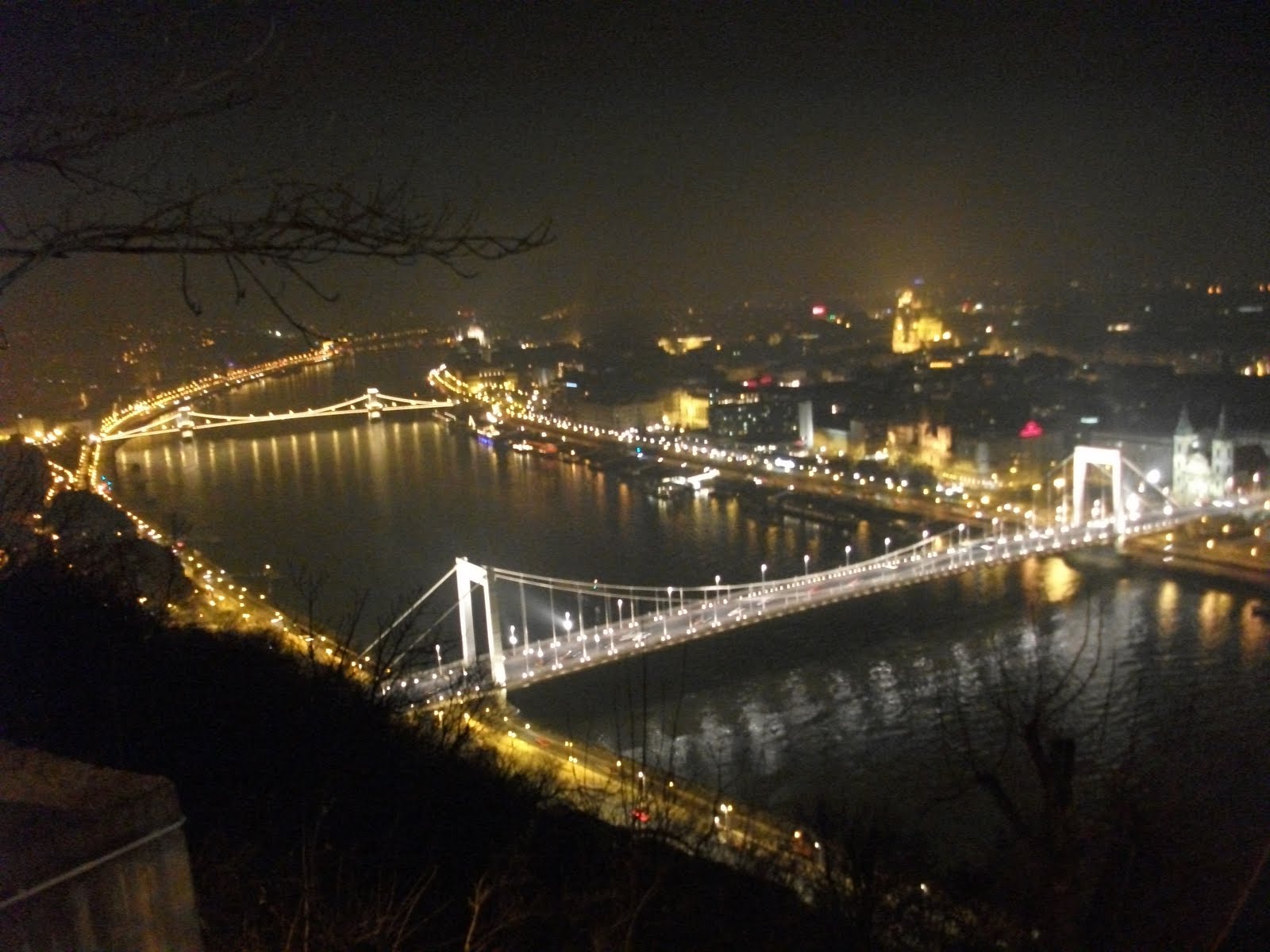
After the school adventure, and with a freshly bolstered vocabulary that enabled me to lovingly purchase a family of storks from a chef while drinking a beer and finding directions to the nearest pub, I was able to relax with the Hungarian family for a few hours. While there, my dad discussed the wonders of the iPad, we watched a sea turtle "boil" video, we were amused by the toddler joyfully running around to avoid having her clothes put on properly, and - alas - we said goodbye to part of the family. The other part of the family took me to a really neat Christian prayer and singing session (the whole family are really solid Christians, which is awesome) and finally the mom and dad showed me some incredible nighttime views of Budapest. Man, with the lights framing the Danube, the Royal Palace rising majestically above the city on the Buda side, and the Parliament building standing proudly on the Pest side, the city was gorgeous! Looking at the view, it's almost too easy to forget the incredible sacrifice and bravery of the Hungarians that helped clear the road to the freedom that they, and Central/Eastern Europe at large, enjoy today. It was especially touching for me to hear from the mother about her father, who was - at my age, as a pre-medical student - a Freedom Fighter in '56. He was nearly executed (many were) as a result of his role in the Revolution, and was imprisoned for six years until the "magnanimous" government let him go, and only then because of his young age and a general amnesty.


Budapest's lights by night

On Saturday, we met some family friends who live in Budapest and we visited a beautiful church - the Mátyás-templom - that featured gorgeous, multi-colored tiles (called Zsolnay tiles) manufactured in Hungary. The Matthias Church (as it's called in English) was built in the 14th century and is a jewel in the heart of Buda's Castle District (basically the digs of the old Hungarian kings). The church afforded great day-time views of the Danube and several of the eight bridges that grace the city. At dinner with some of our friends, my dad was in fine form, and seemed to greatly enjoy the fluid Hungarian discourse that he so rarely experiences in western Maryland..


Some of the Zsolnay tiles


Hungarian Parliament

The last day of my trip (stick with me, almost done) I spent with my dad. It was great fun to stay with him on Margitsziget, a park-like island in the middle of the Danube where my family and I lived for a bit in 1994. For those who don't know, Hungary is home to the largest thermal water cave system in the world, which translates to naturally-heated, hot sulfur-water baths!! While I don't fancy the taste (many people are convinced that drinking sulfur water is great for one's health), I certainly loved lounging around the warm baths in our hotel.. (The faint rotten-egg smell of the sulfur doesn't bother you after too long!) It was cool being there and thinking how, as a three-year old, I had run around the place under the watchful eye of my mother. Margitsziget is also home to a world-class water polo & swimming training facility, complete with plaques acknowledging the many Hungarian Olympic gold medal winners - including the 1956 Olympic gold, home to the famous "Blood in the Water" match, which was set against the backdrop of the Hungarian Revolution against the Soviets. In addition to Margaret Island, we checked out the Vásárcsarnok (a popular market), the Corvinus University of Budapest, the Deák Téri Evangélikus Templom (the church where my dad was baptized), the Great Synagogue (the 2nd largest synagogue in the world), and the wonderful Vörösmarty Tér pre-holiday open-air market (which had AMAZING mulled wine). As we walked through the city, I was struck by the still-extant scars of '56, which were present in the form of bullet holes and obvious signs of combat on many buildings..


Some delicious hot wine

If you are still reading, you have my deep and sincere gratitude! Your prize? Some side notes that may be of interest:

1) Lufthansa ROCKS. After this weekend, it's got to be my favorite airline. I flew 4x with them (I had a connection flight each way) this weekend, but the many travel hours passed very pleasantly because Lufthansa had such great organization, such friendly staff, and such delightful perks. I was treated to food and drinks on every flight and was repeatedly offered extra food, had FREE coffee and tea at the Munich airport (no joke, they had free machines where you just pushed a button and got whatever you wanted), enjoyed free INTERNET at the airport, and in general experienced great overall service.. Viva Lufthansa & viva German competence.

2) I noticed that the word "super" transcends borders and languages. In Spain, it's very common to hear someone say, for example, fue super-bien (it was so good).. To my surprise, the same kind of usage is common in Hungary, where you can say "szuper" whatever. Interesting, no?

3) My study abroad program had another gastronomy session with Núria, our colorful and highly entertaining food experta.. We had a taste-testing of pineapple, cucumbers, and juice under different conditions, to see how we reacted to the same foods presented in different ways. I'm not sure how my tongue reacted to many of the treatments (e.g. blindfolded pineapple-eating vs. normal pineapple-eating) but I know for a fact that my heart and kidneys convulsed when I tried the salt-treated cucumbers! Núria put enough salt on the pepinos to kill a donkey.

4) Aaaaand finally, check out the new "God Corner" feature to the blog.. Enjoy!